Drinking from the Fire Hydrant: Completing MIT's Blended CTO Program and Winning the Impact Project Prize
TL;DR I completed MIT's Blended Professional Certificate in CTO and my impact project team won the fire hydrant prize for a mobility solution for people with reduced mobility. Here is what the experience changed for me.
A few months ago I sat in a classroom at MIT again. Not the kind of classroom you see in movies. This one was blended, part online and part on campus, filled with people who had flown in from industries I rarely intersect with: energy, healthcare, finance, government, and a few of us from tech.
I run two software companies. Most of my learning happens in production, in client calls, in the small hours between a deploy and the next standup. I joined the MIT Blended Professional Certificate in Chief Technology Officer program because I wanted to stress-test that experience against people who solve completely different problems and against professors who study how technology organizations should work. I wanted to see where my instincts were right and where they were just habits.
That turned out to be a humbling exercise.
The Volume
If you have heard the phrase “drinking from a fire hydrant,” you know what MIT feels like. The program throws frameworks, cases, models, and conversations at you faster than you can fully absorb. The hardest part was not the concepts themselves. It was making space for them.
Running Wawandco and Symbol Security means my calendar is already a competitive sport. Adding coursework, group calls, and an impact project forced me to become stricter about what deserves attention. I started blocking learning time the way I block deep work. I stopped pretending I could absorb a strategy reading during a five-minute break. The program did not just teach me roadmapping and figures of merit; it reminded me that growth requires protected time, not leftover time.
One of the early case discussions stuck with me. A manufacturing CTO was deciding whether to build a predictive maintenance platform in house or partner with a vendor. The answer was not in the numbers alone. It was in the organization’s capacity to support the choice over five years. That is the kind of question I do not get to debate as often in my day-to-day, and it made me miss the slower, deeper thinking that good strategy requires.
The Team
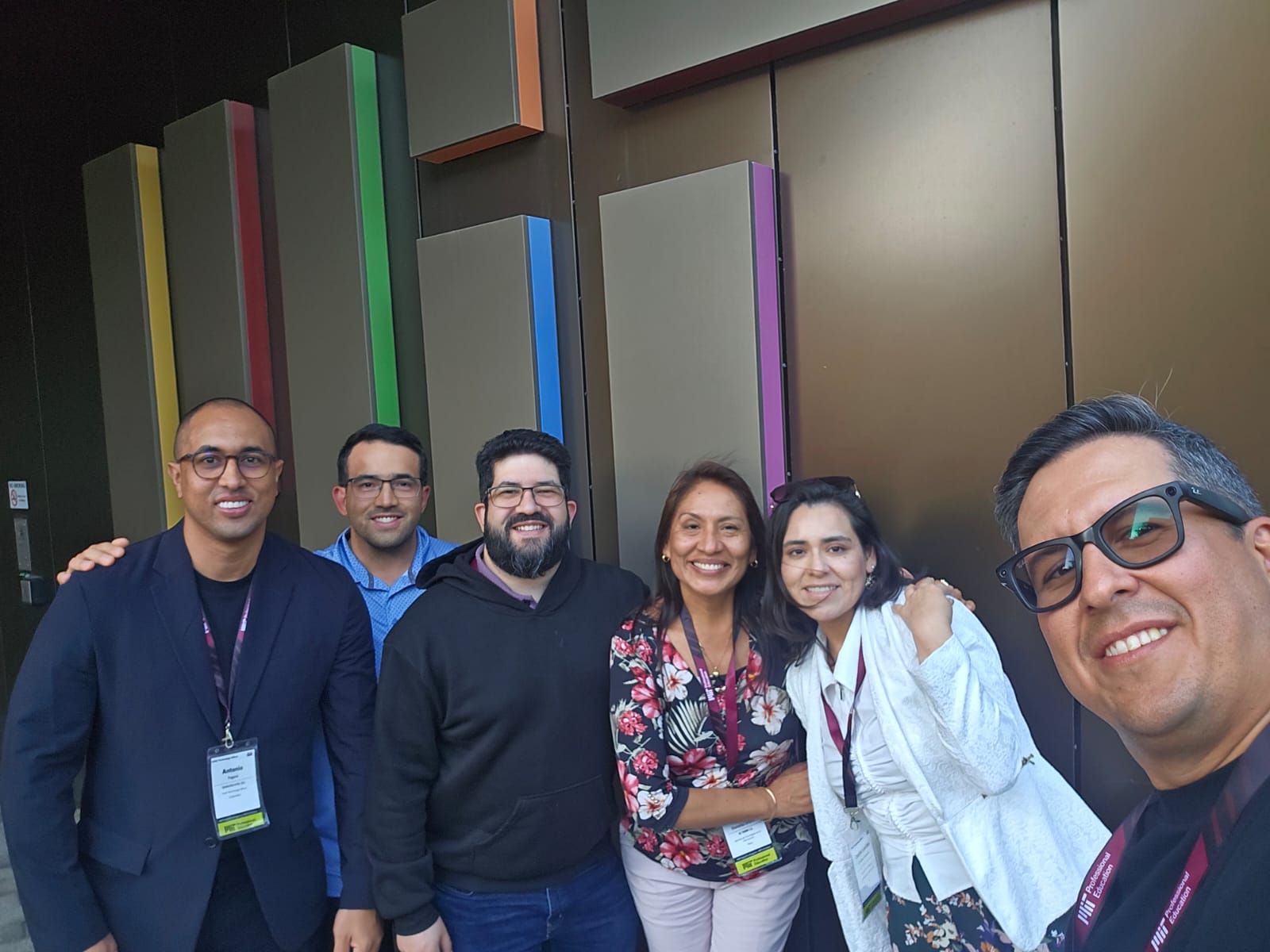
Every impact project team in the program was deliberately mixed. Mine included Manuel, Milagritos, Andres, Cecilia, and Miguel. We came from different countries, industries, and professional backgrounds. What united us was the willingness to argue constructively and to let the best idea win.
We chose to work on mobility for people with reduced mobility. The problem is personal for many families and structural for most cities. Our proposal was an AI-enabled device that uses computer vision and machine-enabled technologies to identify obstacles and facilitate safer, more independent movement. We were not trying to build a full product in a few weeks. We were trying to prove that a focused team with the right framing could design something worth building.
Manuel brought a systems view. Milagritos kept us grounded in the human side. Andres pushed the technical feasibility harder than anyone else. Cecilia made the business case crisp. Miguel asked the uncomfortable questions that kept us honest. I tried to bring the product and engineering lens I use every day, while learning when to shut up and let another discipline lead.
The work was not smooth. We disagreed on scope, on target users, and on how much technology to pack into the first prototype. Those arguments were the most useful part. They forced us to name assumptions that would otherwise have stayed hidden until much later.
What Stuck
The program covered a lot of ground: financial metrics for technology leaders, organizational design, stakeholder communication, and the politics of innovation. Two things stayed with me.
The first is ATRA, a roadmapping technique that forces you to separate aspirations from commitments. For someone who lives in sprint cycles and quarterly OKRs, ATRA felt like a different language at first. By the end, it became a tool I now use when I need to explain to a founder or a board why we are not doing something yet, even if it is a good idea.
The second is the idea of figures of merit. Not vanity metrics. Not dashboards. The few numbers that actually tell you if a technology strategy is working. At Wawandco and Symbol, I have been revisiting which numbers we track and why. The exercise has already changed a couple of product conversations.
The leadership sessions were equally useful, but in a quieter way. They reminded me that the CTO job is less about being the smartest engineer in the room and more about creating clarity. Clarity on priorities. Clarity on tradeoffs. Clarity on what success looks like when the code is invisible.
The Prize
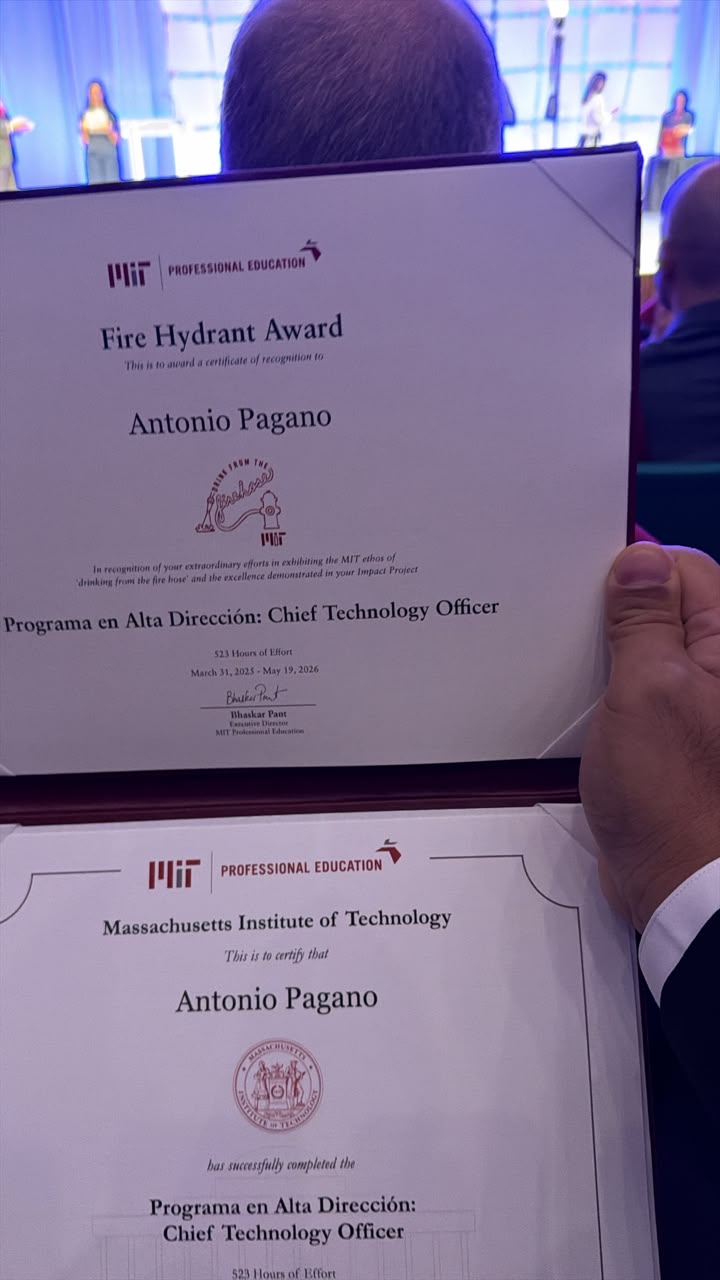
At the certificate ceremony, our team was awarded the fire hydrant prize for the best impact project. The name is intentional. MIT warns students that absorbing the institution’s knowledge feels like drinking from a fire hydrant. Winning a prize shaped like one is a little absurd and completely fitting.
Standing on stage with Manuel, Milagritos, Andres, Cecilia, and Miguel felt less like a victory lap and more like a shared exhale. We had spent late nights wrestling with scope, debating whether our solution was ambitious enough or just ambitious, and rehearsing a pitch that had to land in seven minutes. The recognition was not about one person’s idea. It was about a group of strangers who learned to trust each other fast enough to build something coherent.
The project itself is still just a proposal. But the problem is real. People with reduced mobility face daily friction that most of us do not see. If a small device, thoughtfully designed, can remove even a piece of that friction, the effort will have been worth more than the prize.
What I Take Back
I am back in my regular rhythm now: standups, roadmap reviews, client calls, the occasional production surprise. But something shifted. I am more deliberate about how I allocate my own attention. I am more comfortable saying no to good ideas that do not fit the current roadmap. I am more convinced that the best technology leadership is multidisciplinary.
I have also started asking my teams harder questions. Not because they are doing anything wrong, but because the program made me see how often I accept a comfortable narrative. Is this project actually on track, or are we just busy? Is this metric moving because of our work, or in spite of it? The questions are not new, but the discipline to keep asking them is.
I am also grateful. Grateful to the professors who challenged us. Grateful to the cohort members who asked questions I would never have thought of. And especially grateful to Manuel, Milagritos, Andres, Cecilia, and Miguel, who proved that a strong team can form quickly when everyone cares more about the outcome than about who gets credit.
If you are considering a program like this, my advice is simple: do it, but clear your calendar first. The fire hydrant is real. The only way to drink from it is to stop trying to sip.